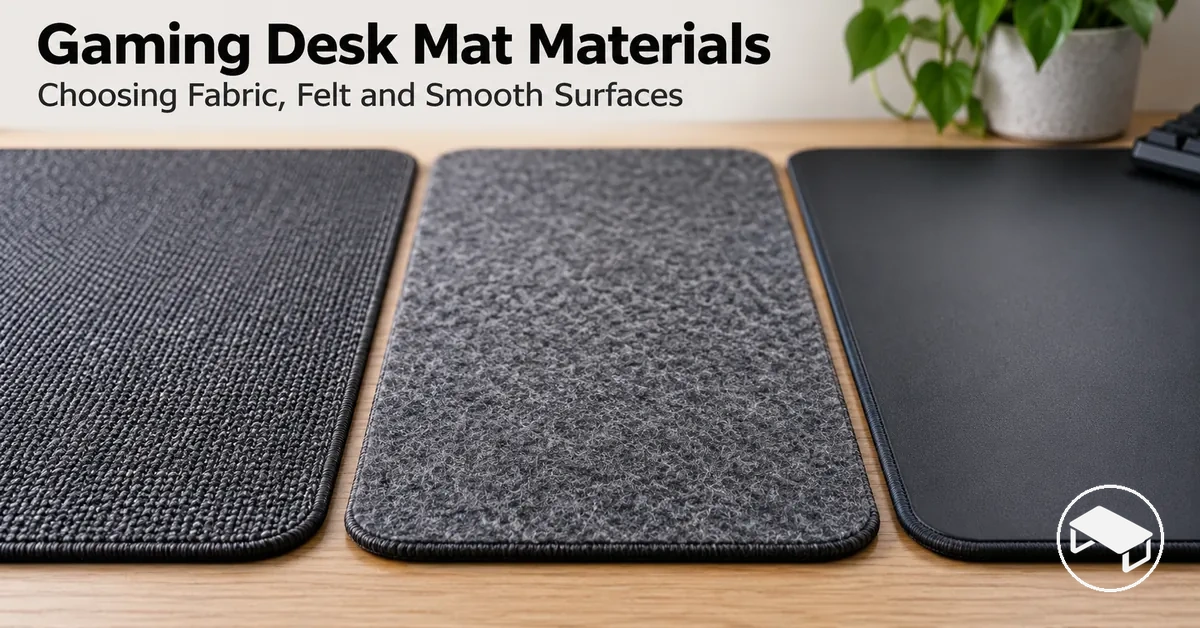
Gaming Desk Mat Materials and Surface Selection
Choose a gaming desk mat by surface texture and finish first, then verify base grip, thickness, edge construction and care limits. Smoother, lower-texture surfaces tend to favour freer glide, more textured surfaces favour a more pronounced stopping feel, and softer fabric or felt constructions can add cushioning; the best fit depends on your mouse feel, desk surface and maintenance needs.
Material selection guide
Match the surface to the behaviour you want
Start with the mouse-contact surface, then use construction details to rule out poor fits. These are conditional profiles, not fixed rankings of material families.
Prioritise: a smoother, lower-texture cloth, hard or coated surface.
Verify: finish consistency, mouse-foot contact, moisture and wear.
Prioritise: a more textured contact surface with greater tactile resistance.
Verify: that resistance stays even rather than becoming patchy with wear.
Prioritise: flexible fabric or felt with cushioning from the surface, base or both.
Verify: thickness and firmness separately; thickness alone does not define comfort.
Prioritise: a non-porous or water-resistant surface only when the construction supports that claim.
Verify: the protected layer, backing, edges and permitted cleaning method.
Final check: material names are only a starting point. The actual weave, fibre density, coating, substrate, base and wear condition determine how an individual mat behaves.
Use the material family to narrow the field, then compare the specific surface and construction attributes that affect glide, stability, cushioning, durability and cleaning.
Table of Contents
Gaming Desk Mat Surface Materials
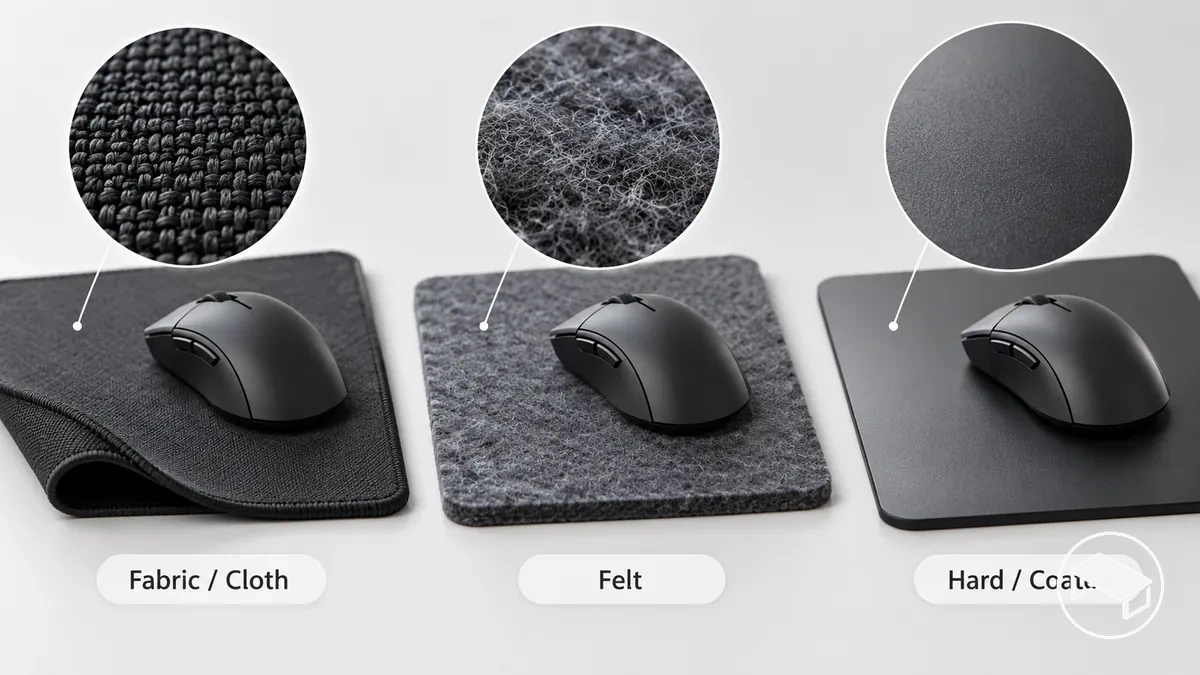
Gaming desk mat surface material can be grouped here into fabric or cloth, felt, and hard or coated smooth surfaces.
Fabric and cloth use a flexible textile surface, felt uses a fibrous and compressible surface, while a hard surface uses a rigid substrate and a coated surface uses a finish over a substrate.
For gaming use, texture and finish are the main comparison axis because they shape friction, comfort, moisture response, and wear.
| Surface family | Texture or finish | Friction tendency | Comfort | Moisture response | Durability |
|---|---|---|---|---|---|
| Fabric or cloth | Woven textile; weave and any surface coating determine how smooth or textured it feels | A smoother weave or coating reduces surface resistance relative to a more textured weave under otherwise comparable conditions | Flexible construction provides a softer contact surface, with cushioning also determined by the base | Uncoated textile can absorb moisture, while a water-resistant surface treatment limits liquid penetration according to the specific construction | Wear is governed by weave, coating, edge construction, abrasion, and care conditions |
| Felt | Fibrous, compressible texture shaped by fibre density and surface finish | Exposed fibres create a more textured contact surface than a smooth hard or coated finish | Compressible fibres provide cushioning between the hand, equipment, and desk | Fibrous construction can retain absorbed moisture, making drying conditions relevant to care | Wear is governed by fibre density, compression, abrasion, and surface-fibre disturbance |
| Hard or coated smooth surface | Rigid hard substrate or a smooth coating applied over another substrate | A smooth finish reduces surface resistance relative to a more textured finish under otherwise comparable conditions | A rigid hard surface provides little material compression; a flexible coated surface takes its cushioning behaviour from the substrate and base | A non-porous or water-resistant finish supports surface wiping when the coating and edge construction are designed for that care method | Wear is governed by substrate properties, coating integrity, abrasion, and cleaning conditions |
Use these as surface-family tendencies rather than fixed performance classes. Weave, fibre density, coating, substrate, base construction and wear can change friction, comfort, moisture response and durability within the same family.
Compare the actual texture or finish and complete construction before deciding which surface fits your preferred mouse feel and maintenance conditions.
Fabric and Cloth Surfaces
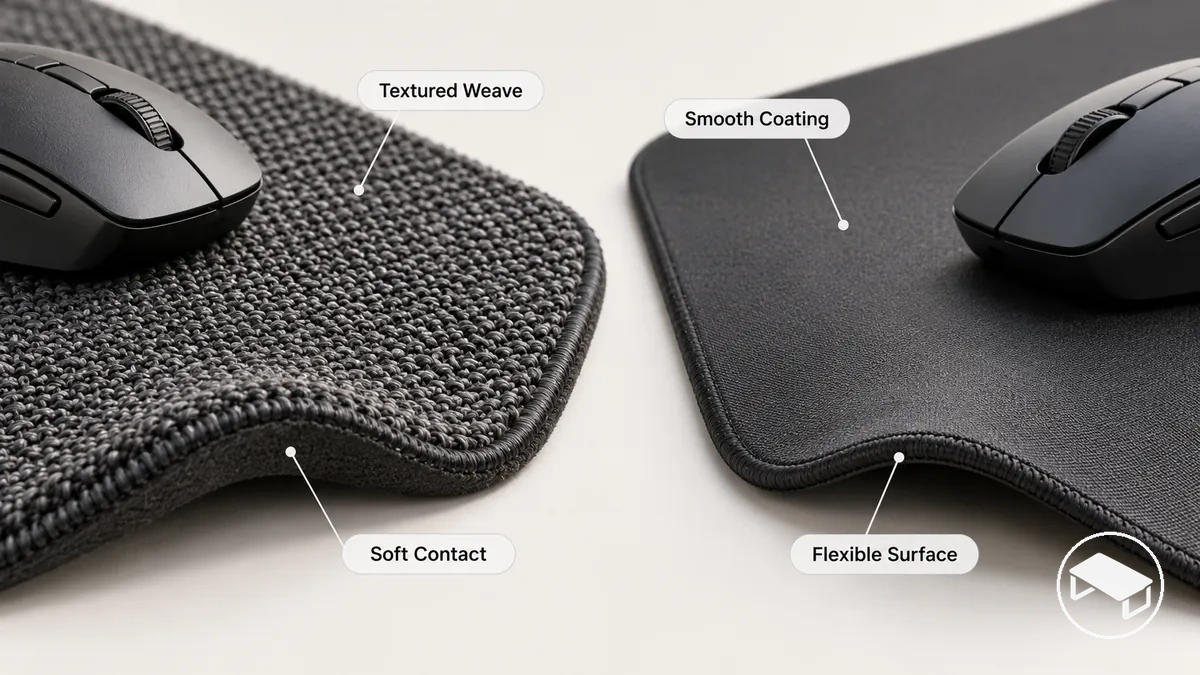
A fabric surface or cloth surface is a flexible woven or knitted textile layer whose feel is shaped by its weave, texture, and any applied coating.
A more pronounced weave creates a more textured mouse-contact surface, while a smoother weave or coating creates a smoother contact condition; flexibility also gives fabric a softer contact feel than a rigid surface.
These construction differences influence comfort, moisture response, wear, and friction consistency.
- Glide tendency
- A smoother weave or coating can favour freer movement; a more pronounced weave can provide greater tactile resistance.
- Comfort
- Flexible textile construction gives a softer contact feel than a rigid surface, with additional cushioning determined by the base.
- Moisture and care
- Untreated textile and coated fabric can respond differently to liquid, so cleaning should follow the specific construction and care instructions.
- Wear
- Abrasion or coating wear can change the texture touching the mouse feet and make friction less consistent over time.
Felt Surfaces
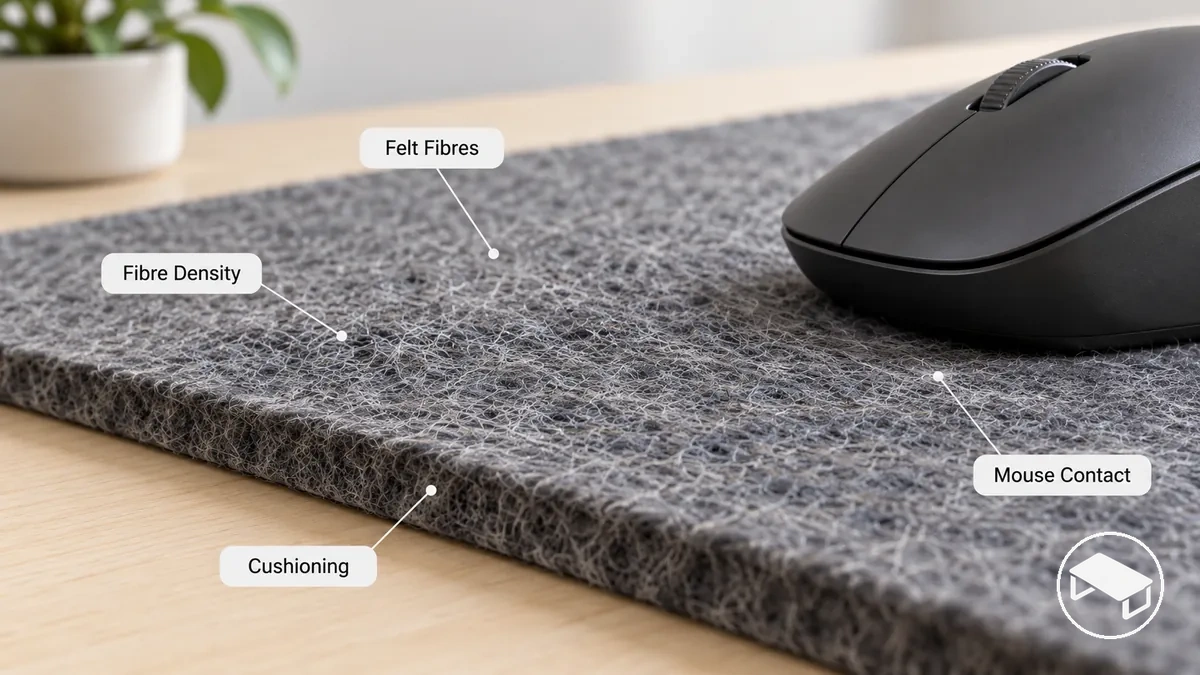
A felt surface is a fibrous, compressible layer formed from interlocked or matted fibres rather than a conventional woven or knitted structure.
Fibre density and surface finish determine how compact or exposed the felt fibres are, which changes texture, cushioning, moisture retention, and wear at the mouse-contact surface.
Felt selection profile
- Surface condition
- Fibre density and finish determine whether the mouse-contact area feels more exposed and textured or flatter and smoother.
- Cushioning
- More compressible fibres can prioritise softness and desk protection; denser felt can present a firmer contact surface.
- Moisture and wear
- Retained moisture, fibre disturbance and possible pilling can change the contact texture and therefore friction consistency.
- Selection rule
- Judge fibre density, finish and condition, not the word “felt” alone.
Hard and Coated Smooth Surfaces
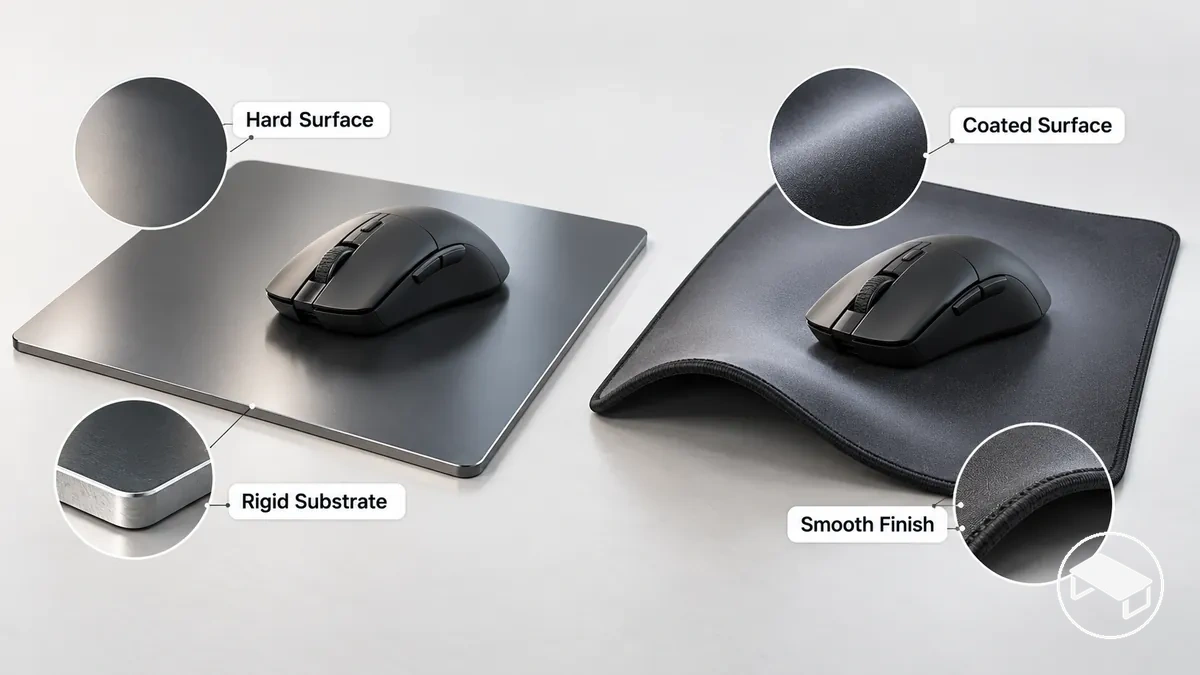
A hard surface uses a rigid substrate as its mouse-contact platform, while a coated surface can use a flexible substrate covered by a smooth finish.
Hard surface
A rigid substrate forms the mouse-contact platform, so the substrate determines rigidity and contributes to contact noise and comfort. It provides little material compression compared with a compressible construction.
Coated smooth surface
A coating creates the immediate contact texture while the substrate determines flexibility. Coating wear can change friction even when the underlying substrate remains intact.
Shared decision rule: a smoother, lower-texture contact can reduce resistance relative to a rougher finish under comparable conditions. A non-porous smooth finish can support wipe-clean care when its construction allows it, but smoothness does not guarantee better tracking.
How Surface Material Affects Gaming Mouse Glide and Control
Gaming desk mat surface material can change mouse glide and control by changing the friction and stopping feel between the mouse feet and the surface.
A smoother surface texture or surface finish can reduce movement resistance relative to a more textured contact under comparable conditions, while greater resistance can make stopping feel more pronounced.
Material alone does not determine mouse performance because the contact condition also changes with surface texture, finish, moisture, applied pressure, and wear.
| Surface attribute | Condition | Friction-related effect | Likely mouse-feel outcome |
|---|---|---|---|
| Surface texture | Smoother versus more pronounced texture under comparable conditions | Smoother contact can reduce movement resistance, while more pronounced texture can increase tactile resistance | Freer mouse glide versus more pronounced stopping feel |
| Surface finish | Uniform smooth finish versus an uneven or changing finish | A uniform finish supports more consistent contact, while finish variation can change friction across the surface | More consistent glide feel versus variable movement resistance |
| Moisture | Dry surface versus moisture-affected contact | Moisture can change friction, with the direction and degree of change depending on the surface material and finish | Mouse glide and control can differ from the dry condition |
| Applied pressure | Greater downward pressure on a compressible surface | Greater compression changes the contact condition between the mouse feet and surface | Mouse glide and stopping feel can change according to the material's compressibility |
| Wear condition | Uniform surface versus worn, polished, or disturbed contact areas | Wear can change surface texture or finish and create friction differences across the mat | Glide and stopping feel can become less consistent across differently worn areas |
For a speed-oriented preference, lower movement resistance can favour freer glide; for a control-oriented preference, greater resistance can create a more pronounced stopping feel. The useful target is consistent friction at the level you prefer, not the lowest or highest resistance in isolation.
Physical glide and sensor tracking are separate criteria. No material or smooth finish by itself guarantees tracking quality.
Select the surface by the friction and stopping feel you want, then verify whether its texture, finish, moisture response and wear condition can maintain that behaviour consistently.
Base Grip, Thickness and Edge Construction
A gaming desk mat’s base material, thickness and edge construction perform three separate structural jobs; they should not be collapsed into one overall quality score.
Primary attribute: grip and positional stability. Practical grip depends on base texture, contact area, desk finish, cleanliness and wear.
Primary attributes: profile, cushioning potential and compression. Firmness and compressibility determine how thickness feels under load.
Primary attribute: perimeter durability and tactile boundary. Stitching reinforces the edge; a raw edge keeps a flatter transition but exposes the boundary directly.
On a smooth or low-friction desk, dust, contamination or incomplete base contact can reduce grip. Under wrist, keyboard or mouse pressure, material firmness changes cushioning and compression, while repeated perimeter contact makes edge construction more relevant to wear.
Assess base grip, thickness and edge construction independently against your desk surface and intended use.
Non-Slip Rubber and Silicone Bases
A rubber base or silicone base can improve a gaming desk mat's grip, but non-slip behaviour is conditional rather than fixed.
Stability depends on base texture, the contact area against the desk surface, desk finish, cleanliness of both contact surfaces, and wear of the base.
A clean base lying flat across its intended contact area can provide more effective grip than the same base when dust, debris, curling, or wear reduces contact.
On a smooth or polished desk such as finished wood or glass, clean, broad base contact supports resistance to sliding. On a textured desk, grip also depends on how well the rubber or silicone base conforms to surface irregularities rather than bridging them.
Verify these conditions before judging a “non-slip” claim:
- Desk cleanliness: Check that dust, crumbs, oils, and other debris are not separating the base from the desk surface.
- Desk finish: Identify whether the contact surface is smooth, polished, or textured because its finish changes how the base makes contact.
- Base cleanliness and condition: Check the rubber base or silicone base for contamination, wear, or surface changes that can reduce effective contact.
- Full contact and flatness: Check that the base lies flat across its intended contact area without curled or lifted regions reducing contact.
Thickness, Cushioning and Surface Stability
A gaming desk mat’s thickness changes its profile and the amount of material available for cushioning, but thickness alone does not determine comfort or stability.
Thinner construction
- Lower desk-to-mat profile.
- Can conform closely to a flat desk when the base lies evenly.
- Offers less material depth for cushioning.
Thicker construction
- Provides more material depth that can contribute to cushioning.
- May compress more when the construction is soft.
- Does not automatically provide greater stability or comfort.
Separate nominal thickness from firmness and compressibility. Two mats with different thicknesses can respond differently under the same load because their materials do not compress equally.
Select the profile and cushioning you prefer, then check how firmly, evenly and stably the complete mat rests on the desk.
Stitched and Raw Edge Durability
A stitched edge can reinforce a gaming desk mat’s perimeter and reduce the risk of fraying, but stitching does not make the edge immune to wear or delamination.
Stitched edge
- Adds perimeter reinforcement where repeated rubbing occurs.
- Can reduce some fraying risk.
- Creates a raised edge profile whose tactile feel depends on stitching quality and condition.
Raw edge
- Provides a flatter transition at the perimeter.
- Leaves the exposed boundary without stitched reinforcement.
- Can be more directly affected by abrasion or fraying where the material permits it.
Either construction can still wear, and bonded layers can delaminate if their bond deteriorates. Washing and care can also affect edge condition according to the mat’s materials and assembly.
The practical trade-off is added reinforcement versus a flatter edge feel; durability still depends on construction quality, abrasion and care.
Water Resistance and Washability by Material
Water resistance and washability are different attributes. One describes how a surface or construction handles moisture exposure; the other describes which cleaning methods the complete mat can tolerate.
Water resistance
Evaluate the protected surface or layer, the exposure condition and how quickly liquid is removed. A water-repellent finish can limit immediate wetting without making the whole mat waterproof.
Washability
Evaluate the complete construction—surface, backing, bonding and edge—against the cleaning method that the product’s care instructions permit.
Selection rule: compare the spill protection you need with the cleaning method you are actually prepared to use. Wipe-clean, washable and machine washable are not interchangeable claims.
Longer moisture exposure can give liquid more opportunity to reach absorbent layers, backing or edges where penetration is possible. Cleaning also introduces mechanical and moisture stress, so care limits matter to durability.
Water-Resistant and Waterproof Surface Claims
Water-resistant or waterproof wording on a gaming desk mat does not automatically mean that every layer, edge, or exposure duration has the same moisture protection.
A water-resistant surface may limit penetration during a splash, while a water-repellent surface coating can reduce immediate wetting at the treated surface; waterproof wording should be interpreted according to the material or construction and exposure condition covered by the claim.
Protection during brief surface contact does not establish the same boundary for prolonged exposure.
A claim describing only the top surface therefore should not be extended to the backing or edge unless those parts are explicitly covered.
| Claim wording | Exposure condition | Likely protection boundary |
|---|---|---|
| Water-resistant | Brief splash or limited surface moisture | May limit moisture penetration at the claimed surface or layer without establishing protection during prolonged exposure or for the backing and edge |
| Water-repellent | Moisture contacting a treated surface finish | The surface coating can reduce immediate wetting at the treated area, but the claim alone does not establish whole-mat protection |
| Waterproof | Water exposure within the conditions covered by the specific claim | Applies to the material or construction identified by the claim; whole-mat protection should not be assumed unless the backing, edge, and relevant exposure duration are also covered |
Do not treat stronger claim wording as automatic protection against every spill condition. Splash resistance, wipe-off behaviour, prolonged exposure and whole-mat protection describe different exposure boundaries.
Read each claim by identifying the protected layer or finish, the exposure condition and duration, and whether the surface, backing and edge are all included.
Washable and Wipe-Clean Surfaces
Washable and wipe-clean are not interchangeable care claims, and a fabric mat should be considered machine washable only when its stated care instructions explicitly permit machine washing.
Wipe-clean
Surface-level cleaning within the stated care limits. It does not imply that the complete mat can be soaked or washed.
Washable
The complete construction permits a broader washing method, but the supported method must still be taken from the product-specific care instructions.
Machine washable
A specific care condition that should be assumed only when the complete mat is explicitly designed for machine washing.
Do not infer cleaning tolerance from the top material alone. Backing, coatings, bonding and edge construction can make two visually similar mats require different care.
Select according to the cleaning method stated for the complete construction; cleaning beyond those limits can increase wear or damage risk.
Choosing a Desk Mat Material for Your Gaming Mouse and Desk Surface
The right gaming desk mat material is the one whose surface and construction trade-offs match your mouse feel, desk surface, comfort needs, likely spill exposure and care tolerance. Start with the attribute that matters most, then use the remaining criteria to eliminate unsuitable options.
- 1Choose the mouse feel.
For freer glide, prioritise a smoother, lower-texture contact surface. For more pronounced stopping control, prioritise greater tactile resistance.
- 2Check desk grip.
Look for a base that can lie flat and maintain clean, broad contact with your desk surface.
- 3Set profile and cushioning.
Choose thickness for the profile you want, then judge firmness and compressibility separately.
- 4Choose the edge trade-off.
Use stitching when perimeter reinforcement matters; consider a raw edge when a flatter tactile transition matters more.
- 5Verify spill and cleaning tolerance.
Match water-resistance claims to the protected layer and exposure condition, then follow the care method supported by the complete construction.
Fabric can span both speed- and control-oriented behaviour because weave and finish vary. Felt places more emphasis on fibrous texture and cushioning, while hard or coated smooth surfaces can provide lower-texture contact when their finish is smooth. Select by actual construction, not material-family name alone.
Use the dominant requirement first, then confirm grip, thickness, edge durability and care compatibility before deciding that a specific mat fits your setup.
The product below is an existing marketplace example for applying these selection criteria.